Paytm: How Vijay Shekhar Sharma Built India’s Mobile Payment Giant from Scratch

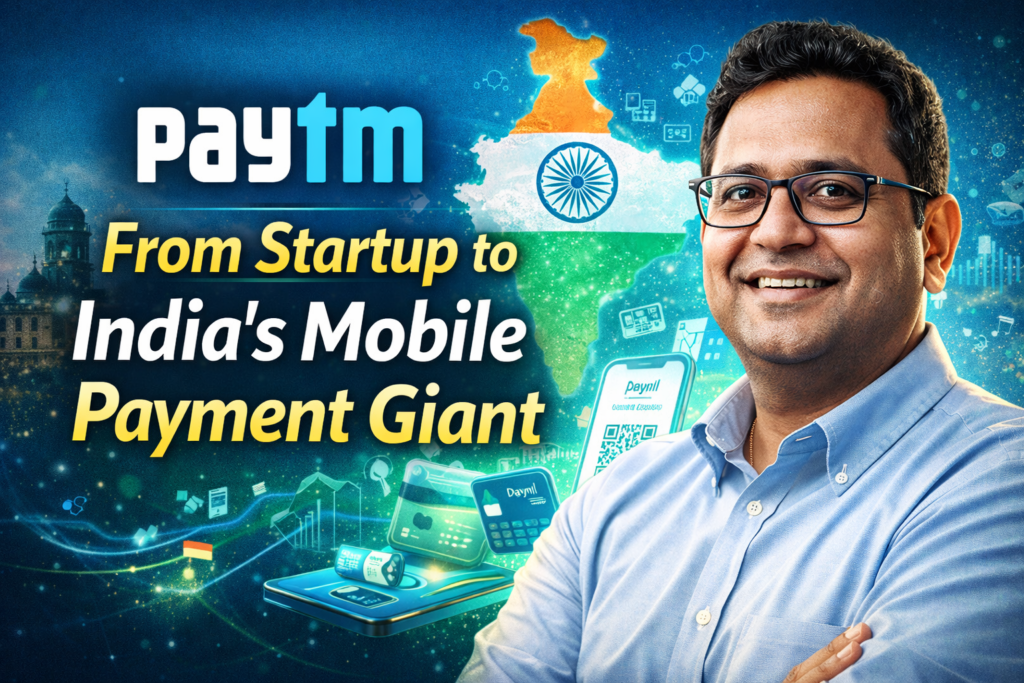
Introduction: India’s Mobile Payment Revolution
In the early 2010s, India’s payment ecosystem was largely cash-dependent, with credit cards and online banking accessible to only a small fraction of the population. Amid this gap, Vijay Shekhar Sharma, a young entrepreneur from Aligarh, saw a massive opportunity: creating a digital payment platform that could bring financial inclusion to millions.
This vision gave birth to Paytm — now India’s leading mobile wallet and digital payment platform, with hundreds of millions of users and a valuation of billions of dollars. From a small startup in Noida, Paytm has redefined how India pays, shops, and transacts digitally, becoming a symbol of the country’s fintech revolution.
2️⃣ Founder Background: Vijay Shekhar Sharma’s Journey
Vijay Shekhar Sharma was born in 1978 in Aligarh, India. From a young age, he showed remarkable interest in technology and business, starting small ventures while still in school. After completing his B.Tech in Electronics and Communication from Delhi College of Engineering, Vijay briefly worked at a software company but was drawn to entrepreneurship.
He moved to Delhi and started his first venture — a website development company — while continuing to explore the potential of mobile technology. Vijay’s vision was always large-scale impact: he wanted to create a platform that could reach millions of Indians, even in small towns and villages.
3️⃣ The Birth of Paytm: Early Struggles and Vision
In 2009, Vijay Shekhar Sharma founded One97 Communications, which would later launch Paytm in 2010. The initial vision was simple: create a mobile recharge platform for prepaid mobile users, enabling digital transactions without the hassle of physical cash.
Challenges in early days:
- Limited smartphone penetration in India
- Lack of trust in online payments
- No clear regulatory framework for digital wallets
Vijay tackled these issues with innovative solutions: easy-to-use interface, robust security features, and a focus on mobile-first India.
Paytm’s first big breakthrough came with mobile recharge and bill payments. Users could recharge prepaid phones, pay electricity bills, and book tickets online, all through their phones — a revolutionary concept in India at that time.
4️⃣ Growth Phase: From Mobile Recharge to Digital Wallet
After initial success, Paytm rapidly expanded its offerings:
- Digital Wallet Launch (2014): Paytm introduced its mobile wallet, allowing users to store money digitally and pay at merchants nationwide.
- Aggressive Marketing & Incentives: Cashback offers, referral programs, and discounts attracted millions of users.
- Merchant Integration: Small businesses and shops began accepting Paytm, increasing adoption across India.
By 2015, Paytm had millions of users and hundreds of thousands of merchants onboard, establishing itself as India’s leading digital payment platform.
5️⃣ Turning Points: Demonetization and Rapid Expansion
The biggest turning point for Paytm came in November 2016, when the Indian government demonetized ₹500 and ₹1000 notes. Cash transactions plummeted overnight, and Paytm emerged as the primary alternative for millions of Indians.
- User Base Explosion: Over 100 million new users signed up in a few months
- Increased Transactions: Bill payments, online shopping, and peer-to-peer transfers surged
- Investor Confidence: Alibaba, SoftBank, and others invested heavily
This event cemented Paytm’s place in the Indian fintech ecosystem, transforming it from a startup to a unicorn almost overnight.
6️⃣ Diversification: Beyond Payments
Vijay Shekhar Sharma knew that Paytm could not just be a wallet; it needed to become a full financial services ecosystem.
Major expansions included:
- Paytm Bank (2017): A digital bank offering savings accounts and payments
- Paytm Payments Bank App: Seamless transactions, savings, and bill payments
- E-commerce Platform: Paytm Mall to compete with Amazon and Flipkart
- Financial Products: Insurance, mutual funds, loans, and credit services
These innovations allowed Paytm to cater to multiple segments of the Indian population, from metro cities to rural towns.
7️⃣ Challenges Faced
Paytm’s journey wasn’t without hurdles:
- Competition: Google Pay, PhonePe, MobiKwik
- Regulatory Challenges: RBI compliance and digital payment regulations
- Technology Scaling: Handling millions of transactions per day required robust infrastructure
Vijay Shekhar Sharma tackled these challenges by investing heavily in tech infrastructure, partnering with banks, and innovating continuously.
8️⃣ Current Status: India’s Digital Payment Leader
As of 2026, Paytm is:
- Valuation: Over $20 billion
- User Base: 350+ million users
- Merchant Network: Millions of offline and online merchants
- Services: Wallet, banking, loans, insurance, mutual funds, e-commerce
Paytm continues to lead the digital payment revolution in India, while expanding fintech offerings and solidifying its position as a household brand. Vijay Shekhar Sharma is regarded as one of India’s top tech entrepreneurs, inspiring a new generation of startup founders.
9️⃣ Lessons from Paytm
- Solve a Real Problem: Focus on India’s cash-heavy economy and lack of digital infrastructure
- Timing Matters: Demonetization accelerated adoption massively
- User-Centric Design: Simple mobile-first interface made Paytm accessible to millions
- Innovation & Diversification: Payments, banking, financial products
- Resilience: Competition, regulations, and tech challenges were overcome with vision and persistence